
 Keynote Speaker
 Service Catalog
 717-790-8723
What SCP’s GROWTH Index™ and recent LinkedIn poll reveal about the real drivers of organizational excellence
Organizations today are navigating rapid change, workforce burnout, hybrid complexity, and rising expectations for transparency and alignment. In this environment, leadership behaviors matter more than ever—not in abstract, theoretical ways, but in daily, observable actions that shape trust, engagement, and innovation.
Last week, SCP asked a simple question on LinkedIn: What’s the most underrated driver of organizational excellence? Here are the results:
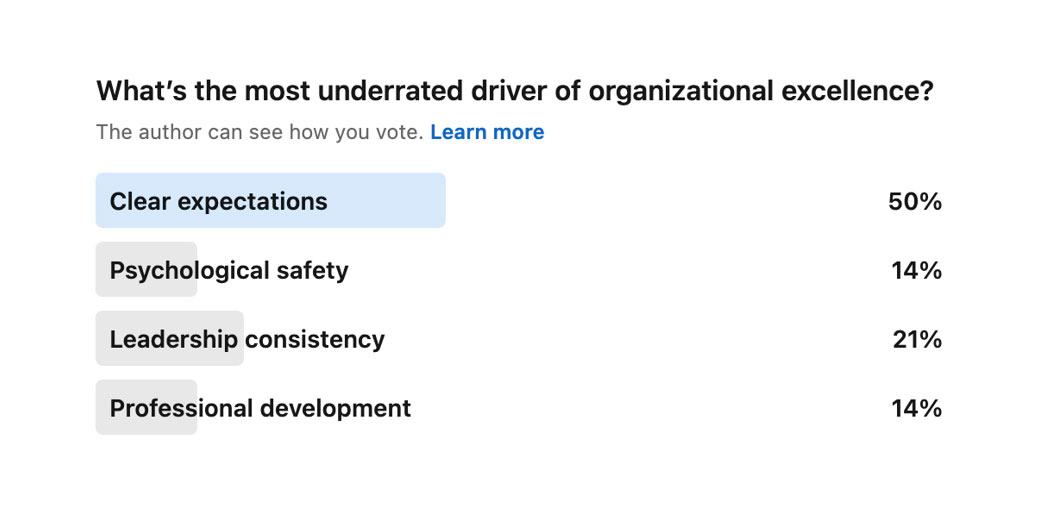
The options were:
- Clear expectations
- Psychological safety
- Leadership consistency
- Professional development
The top response? Clear expectations.
Yes, it is true that clear expectations are essential, although insights from the SCP GROWTH Index™ tell a fuller story. At SCP, we know that in order for the work to get done and for teams to function well, clarity of expectations is very important, but what’s underneath? Leadership behavior. Is leadership behavior consistent and demonstrating transparency, trust, support, accountability, and understanding?
These four elements build on one another: consistent leadership creates clear expectations; clear expectations build trust; trust fosters psychological safety; and psychological safety strengthens engagement, learning, accountability, adaptability, and innovation. Together, they create the conditions for organizational excellence.
This is the strategic edge many organizations miss.
1. Leadership Consistency: The Foundation of Organizational Excellence
Across SCP GROWTH Index™ assessments SCP has conducted in the last year, the strongest predictors of organizational health are leaders who consistently communicate effectively, demonstrate accountability, act with trustworthiness, and foster inclusion. These leadership behaviors shape the broader employee experience.
People don’t expect perfection. They want leaders they can count on.
When leaders communicate openly, act with integrity and honesty, provide regular support and feedback, demonstrate empathy and understanding, employees experience psychological safety and stability. This creates trust. Trust fuels engagement. Engagement enables people and organizations to thrive.
SCP Data Insight: Organizations scoring in the top quartile for leadership consistency show:
- Significantly higher psychological safety and innovation behaviors
- Better alignment with purpose and mission of the organization
- Less employee turnover
- Strong levels of accountability and organizational results
Consistency in these leadership behaviors is what multiplies the impact of every other leadership action. Consistent leadership creates clear expectations.
2. Clear Expectations: The Crowd Favorite—and the Second Most Critical Driver
The LinkedIn poll revealed what many employees feel daily: ambiguity drains energy and creates frustration, while clarity fuels performance and alignment. Clear expectations reduce friction, prevent rework, and strengthen alignment.
But clarity does not exist in a vacuum.
Clear expectations depend on upstream leadership behaviors, as seen in #1:
- Consistent open and honest communication
- Consistent modeling of values
- Consistent support and feedback
- Consistent follow through and accountability
When leaders shift direction frequently, communicate reactively, or apply standards unevenly, expectations become muddy—even if leaders believe they are being clear.
When employees lack clear expectations, they experience greater stress, lower job satisfaction, reduced commitment, and decreased performance.
When employees understand what is expected of them, how success will be measured, and how their work contributes to broader organizational goals, they are better equipped to make decisions, collaborate effectively, and take ownership of results. Clear expectations provide the foundation upon which accountability, trust, and high performance are built.
SCP Data Insight: Clear Expectations:
- Create alignment. Employees who understand goals, priorities, standards, and accountability are more likely to feel connected to the organization’s purpose.
- Build trust. Higher clarity is associated with greater confidence in leadership, stronger supervisor relationships, and better perceptions of fairness.
- Strengthen teamwork. Teams with greater clarity tend to report stronger collaboration, communication, accountability, and follow-through.
- Support psychological safety. When expectations are understood and applied consistently, employees are more comfortable speaking up, giving feedback, and learning from mistakes.
Clear expectations create a safer place with stronger psychological safety, providing furtile grounds for innovation.
3. Psychological Safety: The Engine of Innovation
Psychological safety is not about comfort—it’s about candor without fear. It is the condition that allows employees to speak up, surface problems early, and share ideas that challenge the status quo. Consistent leadership builds trust and psychological safety.
SCP’s GROWTH Index™ shows that psychological safety rises sharply when:
- Leaders communicate consistently
- Expectations are clear
- Feedback is shared openly
- Mistakes are treated as learning opportunities
When leadership behavior fluctuates, psychological safety collapses. Employees begin to “read the room,” not the strategy. They adapt to personalities, not priorities.
SCP Data Insight:
In organizations where psychological safety is high, we see high alignment with purpose, higher scores in inclusion, innovation, and continuous improvements, contributing to better teamwork. Psychological safety is created by leadership behavior and enables learning, growth, and professional development.
4. Professional Development: A Powerful Driver That Depends on the First Three
Professional development is essential for retention, engagement, and succession planning. But development cannot thrive in environments where expectations are unclear; feedback is inconsistent, or psychological safety is low.
Employees take development seriously when leadership demonstrates that growth is valued, supported, and expected.
SCP’s client data shows that when learning and talent development are strong, employees are more likely to receive feedback, feel supported, and be capable of achieving their professional goals.
Learning and development act as an accelerator, strengthening engagement, enhancing innovation, fueling retention, and building confidence for greater overall organizational health.
The strongest learning cultures are built by leaders who consistently invest in their people.
What the Poll Reveals—and What the Data Confirms
The poll results and the SCP GROWTH Index™ findings tell a powerful story:
- Employees crave clear expectations because they often lack them.
- Organizations thrive on leadership consistency because it creates the conditions for clarity.
- Psychological safety and development flourish only when consistency and clarity are present.
The strategic takeaway is simple and profound:
Employees gain clarity when leaders provide direction and support in a consistent way. The organizations that perform best are often those where employees know what is expected and can rely on leaders to reinforce and support those expectations every day.
If leaders want clarity, engagement, and innovation, they must start with the behavior that shapes them all: consistency.
Organizational excellence is not created by any single leadership behavior; it is created when consistency, clarity, trust, safety, and growth reinforce one another over time.
The Four Most Critical Leadership Behaviors (Based on SCP Data)
- Communicate Openly and Honestly – Build trust and psychological safety by sharing information clearly, transparently, and respectfully, even if the message is difficult.
- Model the Behaviors You Expect – Act with honesty and integrity, follow through on commitments, and take accountability when mistakes happen.
- Provide Regular Support and Feedback – Use consistent coaching and feedback to build confidence, accelerate development, and ask for feedback in return.
- Demonstrate Empathy and Understanding – Treat employees with dignity and respect, seek to understand their experience, and model vulnerability in ways that strengthen psychological safety.
When leaders practice these behaviors consistently, they create trust, clarity, and psychological safety that allow people and organizations to thrive.
The Strategic Edge for Today’s Leaders
Clear expectations are built through consistent leadership. When leaders communicate, reinforce priorities, and follow through consistently, employees are more likely to experience clarity, engagement, and trust.
Maintaining strong organizational health begins with consistent leadership.
Consistency is the new charisma. It is the leadership behavior that builds trust, fuels engagement, and unlocks innovation.
If you want organizational excellence, start with the behavior that makes all others possible: Leadership consistency.
Interested in learning more about the SCP GROWTH Index™ and how it can help you to gain more insights in your organizational health?
Discover what is driving your organization’s success and where opportunities for growth exist with the SCP GROWTH Index™.
Contact Strategic Consulting Partners today to start the conversation.
Contact Us